PCB Assembly Process: From BOM Review to Tested PCBA
MOZPCB Editorial Team (PCB manufacturing guides) · Updated 2026/11/02
Explore manufacturing and assembly guides →
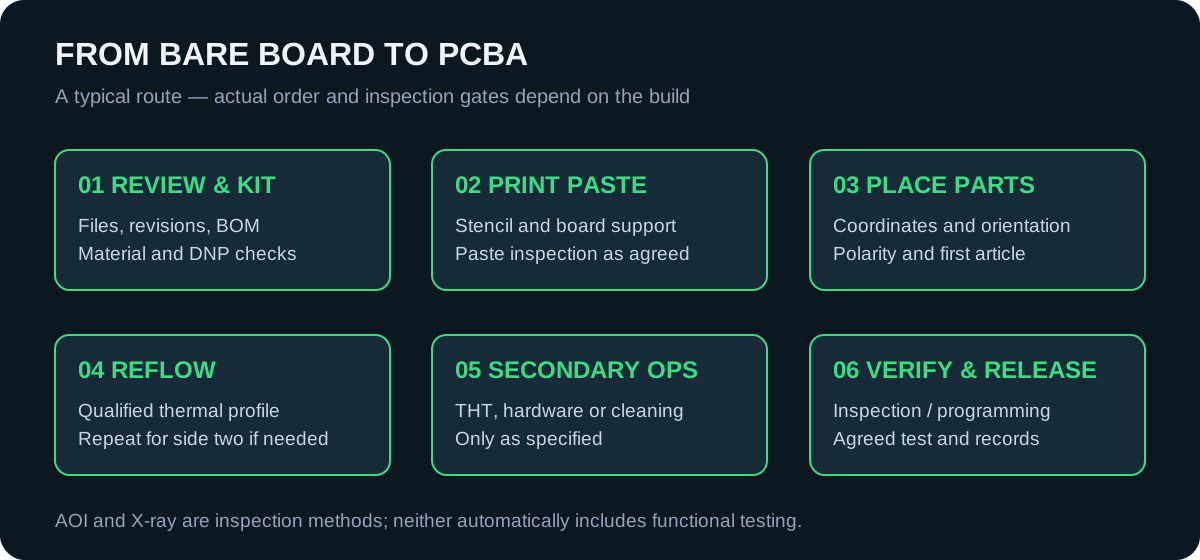
The PCB assembly process converts a bare board and a component kit into a populated circuit board. A typical SMT route includes data review, material checks, solder-paste printing, component placement, reflow soldering and inspection. Through-hole parts, programming, cleaning and test add operations when the design requires them.
The route is not identical for every board. Double-sided SMT, heat-sensitive connectors, bottom-terminated packages and mixed technologies affect sequencing and tooling. A good quote defines those choices before material is purchased or a stencil is cut.
1. Review the BOM, drawings and material plan
Check that the BOM, centroid, fabrication files and assembly drawings share the same revision. Confirm manufacturer part numbers, package sizes, polarity, DNP positions and approved alternates. Resolve discrepancies before kitting; a correct part value in the wrong package cannot be fixed by placement programming.
Incoming material review should address quantity, packaging, traceability and moisture handling as applicable. Consigned and turnkey builds have different sourcing responsibilities, so document who supplies shortages, spares and replacements. See the turnkey RFQ checklist.
2. Print solder paste and verify the deposit
A stencil controls solder-paste deposition on SMT lands. Aperture size, stencil thickness, paste choice and board support must suit both large thermal pads and small components. A single global paste reduction is rarely a complete design rule for a mixed BOM.
Where specified, solder-paste inspection evaluates deposit location, area or volume before components hide the print. Printing defects can lead to bridges, opens or insufficient joints later. Confirm special aperture strategies for exposed pads with the assembler rather than changing the fabrication pad geometry to compensate informally.
3. Place components and reflow
Placement machines use package libraries, feeder assignments, centroid coordinates and fiducials. Rotation and origin conventions need verification, especially for polarized parts and bottom-side components. A first-article check should catch interpretation errors before the remaining lot is assembled.
Reflow heats the assembly through a controlled profile suitable for solder paste, components and the board. Use the material and component limits to develop the profile; one universal peak temperature is not appropriate for every BOM. Double-sided boards may require a second printing, placement and reflow sequence with a plan for already mounted parts.
4. Complete through-hole and secondary operations
Through-hole parts may be soldered by wave, selective or manual methods, depending on volume, access and thermal constraints. Fixtures, masking and process order should protect components already on the board. Press-fit connectors have their own tooling and acceptance needs and are not ordinary soldered joints.
Cleaning, conformal coating, staking, heatsinks and mechanical hardware belong in the process scope when required. “No-clean” flux does not automatically eliminate cleanliness review for every application, especially where coating adhesion or leakage is critical.
5. Inspect, program and test against explicit criteria
Agree inspection coverage and acceptance criteria before production. Optical inspection cannot see every hidden joint, and X-ray does not establish that firmware and circuit functions are correct. Functional test requires defined stimuli, equipment and limits.
| Check | Useful evidence | Important limitation |
|---|---|---|
| AOI / visual | Visible placement, polarity and joint features | Hidden interfaces may be inaccessible |
| X-ray | Hidden solder geometry and selected void/bridge evidence | Not proof of every electrical function |
| Electrical test / ICT | Defined nets, values or circuit conditions | Coverage depends on access and fixture |
| Programming | Approved image loaded and verified | Not necessarily a functional test |
| Functional test | Specified behavior under defined conditions | Only covers the supplied test plan |
6. Release the lot with the right records
Define what the delivery package must contain: assembly revision, quantity, inspection or test records, serial numbers where required, firmware version, deviations and packaging. First-article approval may be a release gate for the balance of the lot rather than a document produced after everything is finished.
For an RFQ, supply the BOM, centroid, assembly drawing, fabrication package, DNP list, sourcing model and requested test scope. Identify who owns fixtures and test software. The Gerber/BOM/placement checklist helps close file gaps before requesting an assembly quote.
Frequently asked questions
What is the difference between fabrication and assembly?
Is every assembled board functionally tested?
Can SMT and through-hole parts be on the same board?
What determines assembly lead time?
Related articles
- PCB Assembly2026/10/13 · 4 min
Turnkey PCBA RFQ Checklist
Everything a turnkey PCB assembly quote request needs—fabrication data, BOM and sourcing notes, assembly instructions, and test requirements—in one reviewable package.
Read article - PCB Assembly2026/10/12 · 5 min
How Much Does PCB Assembly Cost? A Cost-Driver Guide
PCB assembly cost is driven by setup charges, placement count and package mix, test and inspection scope, and sourcing model—here is how each factor moves the quote.
Read article - PCB Assembly2026/10/12 · 5 min
Gerber, BOM, and Pick-and-Place File Checklist for PCB Assembly
The assembly-specific data package a PCBA quote needs: BOM structure, centroid/pick-and-place conventions, and assembly-drawing details that prevent placement and polarity errors.
Read article - PCB Assembly2026/07/20 · 5 min
BGA Assembly and X-Ray Inspection Explained
Why area-array packages need paste and pad design review, when AOI is not enough, and how X-ray inspection fits prototype and production PCBA gates.
Read article